How to Model Ownership and Dilution, and How Pro Rata Works in Venture Capital Deals
· Updated · 4 min read
When you raise $1M on a $5M valuation, that’s selling 20% of the company, right? So what happens when you then raise $7M on a $25M valuation? You’ve sold another 28%, so you’re out 48% of your company. Actually, no. Here’s why.
When it comes to modeling dilution and pro rata rights, a simple calculation lets you build out your current and future financing scenarios and see how ownership plays out over the long run.
You can access my cap table calculator here to download and follow along with this article, or use for your own purposes. If you have questions or need help, comment, email me, or find me on Twitter at @chloealpert.
Start at incorporation

That’s a standard incorporation table. Most companies incorporate a C corporation with 10M shares, though you don’t have to. You can incorporate with any number you want, and round numbers make the math easier. You also set a par value for your shares, which can be as low as you like, usually $0.0001 or some variation, so you can purchase your stock for next to nothing (because it’s currently worth nothing) and file your 83(b) election.
Modeling the seed round
Now assume you go out and raise $1M on a $5M pre-money valuation. Here’s the table.

The seed investor took 20% of the round, but their ownership on a post-money basis is actually 16% once you account for the total number of shares between the founders and the employee option pool.
Modeling the Series A
Now do a Series A where the same company raises $7M on a $25M pre-money valuation. The Series A investors take 28% of the round, and modeled out on a post-money basis, that investor ends up with 21.8% of the company.

How pro rata rights work
Seed and Series A investors generally have ownership targets to maintain. So let’s do a Series B where the Series A investor exercises their pro rata rights to hold their percentage.
Translated literally, pro rata means “according to the rate.” The way to think about it is the right to maintain a proportional ownership percentage of the company.
“You invest $50k in a seed round at a $5mm cap and own 1% of the company. The next round is a $3mm round at $9mm pre, $12mm post. If you don’t participate, you will be diluted 25% and will then own 0.75% of the company. On the other hand, if you buy 1% of the round, a $30k investment, you will continue to own 1% of the company. Your ‘pro-rata right’ in this situation is a $30k allocation in the next round.”
Via Jason Rowley
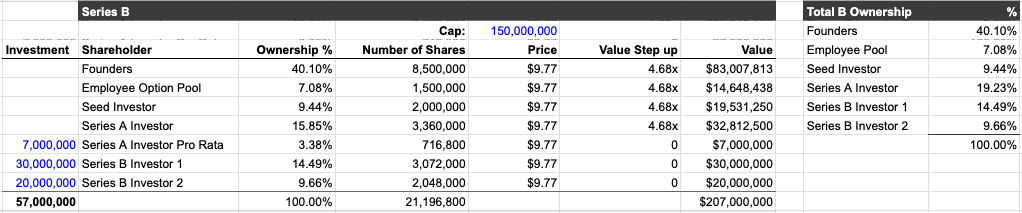
The math for a pro rata amount is simply (target ownership %) x (number of new shares being issued) x (share price at the new round). That’s reflected below. The original Series A investment gets diluted the same as everyone else, and the new money invested as pro rata brings the investor back to their ownership target.
Dilution versus the step up in share price
A few things to notice in this Series B. Even though the founders have been diluted below 50% ownership, the 4.6x step up in valuation means founder equity is now worth over $83M on the same number of shares. When you raise money, you have to understand the balance between dilution and step ups in share value. You can’t always optimize for dilution. If you truly care about maintaining ownership of your company, you probably shouldn’t take venture capital in the first place.
That aside, you can see the Series A investor put in additional capital to execute their pro rata right and hold close to a 20% ownership target. They most likely won’t participate beyond the B, and that decision comes down to their business model and fund mandate. I wrote about why fund mandates work that way in why venture capital firms with tons of money can’t write little checks.
When founders have to limit pro rata
Not every investor executes their pro rata rights, and if you let too many of them do it, there isn’t enough room to complete the round without losing your shirt. Investors understand that founders who are over-diluted early lack the incentive to keep operating. So even with math driving the valuation, founders sometimes have no choice but to block or limit the pro rata amounts of existing investors. That can produce hurt feelings and some angry words, and it’s one of the genuinely unpleasant parts of raising money, especially as you get bigger and start making real revenue.
Series C and the case for a secondary sale
To close it out, let’s take the company through a Series C and hit unicorn status on a post-money basis. The founders still own quite a lot, and what founders typically do at this round, and often at the B, is a secondary sale.
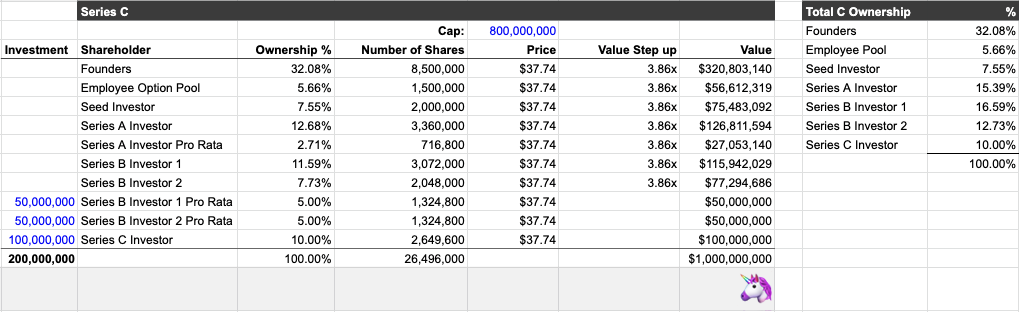
Investors push for founders to sell a small piece of their private stock to give them some initial liquidity for their time. The theory is that a founder with a little liquidity is less risk-averse about pushing the company to go big. It also frees up shares for existing investors who want to expand their ownership before an IPO.
All in, this is a quick simplification of a genuinely complex topic, but it should give first-time founders a sense of how to model ownership and investment in their companies and plan ahead.